

From ore to algorithm
Tracking the real AI supply chain + what's happening with global energy flows

Good afternoon, I hope!
The UK is currently basking in beautiful bursts of sunshine, and I’m (Riddhi here 👋🏼) stuck inside a library. So, if I’m head down in deep academic mode, I’ve decided it’s only fair to extend my curriculum to you all too.
This week’s edition has been inspired by two things. The first being some of my readings from the Oxford Internet Institute, which has been doing all sorts of research into the environmental impacts of AI (don’t worry, this is not sponsored content).
Secondly, while I was in line for my vanilla cappuccino (try it, you will not be disappointed) I was thinking about what it means to pay £5 for a coffee. It always seems like an inane amount to pay for one drink that will likely constitute a forgettable 30-minute experience. But then again, I remind myself that someone is making that drink for me. I’m not just buying the beverage — I’m sitting in a coffee shop, and reaping the efforts of someone’s hard work. That cost makes up their livelihood, and we would hope they’re getting fairly compensated for it; the drink is just the end of the supply chain. The value of labour has become so sidelined that we don’t factor it into the equation.
Which brings me to today’s topic, albeit from this slightly tangential spiral. We’re deconstructing what — and who — actually makes up the AI supply chain.
I’ve come across some great eco-critical perspectives of what developing AI models actually entails. Yes, AI uses a lot of water, and it has a ludicrous carbon footprint. But the scope of its supply chain also extends far beyond data centres and GPUs. There is growing scholarship in a field called critical infrastructure studies that looks at the geographic, material, and economic asymmetries interwoven into the AI industry — and that’s what we’re looking at today.
It’s important to make sense of how technology is deployed because, as with most things, it’s not neutral. What communities form the backbone of this technological development? Are they being adequately compensated for the work put into developing these AI models? Are they being reimbursed for any of the shortfalls caused by these large-scale infrastructure projects?
Academic researchers including Professor Anna Tsing, Dr Ana Valdivia, Pengfei Li, and Jianyi Yang, amongst many others, have conducted fantastic research into the concept of supply chain capitalism1 — and applied this framework to technology.
Here’s what we need to be paying more attention to when it comes to calculating the climate and human cost of AI.
E-waste
AI has a material cost. Namely, e-waste isn’t really brought into mainstream discussions around the climate impacts of AI, because the discussion about the life cycle of these models often ends with data centres.
But what about the end-of-life treatment for products that have been used in the process, such as chips?
Academic research has found that 100% of the components needed in the manufacturing of AI models, such as Ethernet cables, networking components, servers and IT storage could end up in e-waste treatment plans. Globally, only 17.4% of e-waste is currently properly disposed of and recycled, and much of it is either dumped in landfill or incinerated.
A problem is that hardware technology has been rapidly progressing. Devices such as GPUs and servers often have a lifespan of just three to five years, and we don’t really have a way to re-use them. This technology also needs to be constantly updated, and if it is recycled, it needs to be done cautiously.
There’s no concrete solutions to curb this e-waste yet, but it’s an arena that merits more research funding.
Labour
The invisible labour that’s not accounted for in the development of foundational models merits multiple investigations (read some here and here). But for the sake of time, the TLDR is that the digital workplace has transformed how labour structures operate.
More often than not, workers are subjected to really exploitative conditions, may it be data labellers in the Global South to cobalt miners in the Democratic Republic of Congo, which both sit downstream in the AI industry.
Labour is an integral part of the AI supply chain, and so much of this new technological economy is hinged on precarious work. These workers, often outsourced as contractors, have poor pay, few employment rights, and unreasonable hours in which they have to complete their work. Our ability to reap the benefits of this technology is the direct result of these exploitative labour practices.
It also hobbles this very concept of tech sovereignty. Your mighty AI model isn’t a symbol of national prowess or independence if it’s only possible off the back off swindled labour in the Global South.
Data centres and environmental racism
Data centres aren’t arbitrarily constructed. It’s worth questioning why so many (examples here) are built in such close proximity to BIPOC communities who are living below the poverty line, and often result in the siphoning of their water and land resources. It’s an apt example of supply chain capitalism; companies can waltz into territories with cheaper labour costs and ample resources, and and plunder it to raise their bottom line.
Case in point, let’s take Querétaro, a data centre hub in Mexico that’s inhabited by a large proportion of campesino and indigenous communities. Dr Valdivia’s research took her to the central Mexican city; once noted for its striking Spanish architecture and Baroque aesthetic, it’s now the centre of gravity for Big Tech’s data centre boom. Amazon, Microsoft, and Google have already lined up multibillion dollar investments into data centres in the region — which, by the way, is drought-prone.
The city’s location makes it a strategic kingpin; it connects well to most parts of the country, including proximity to Mexico City, and benefits from high-speed data cables. Power grids in the US are also often hit with capacity constraints, so Big Tech giants are always eyeing alternative regions where land and energy can come at cheaper costs. Querétaro is no exception, and its citizens are shouldering the strain.
Water has been the defining feature of a historical struggle in the region since the colonial era. In fact, 17 out of 18 municipalities in the city suffer from drought. To sum up Tramas’ excellent deep dive into the topic (check it out here), Querétaro has been subjected to deeply extractive practices that have pillaged the region of its natural resources as automotive companies, industrial parks, and now data centres set up shop. Data centres need huge amount of water for cooling purposes; at their peak, large data centres can swallow up to 5 million gallons per day. (That’s equivalent to the water use of a town populated by 10,000 to 50,000 people.) Some estimates previously had Querétaro’s total data centre capacity at 160MW, generally the benchmark for a hyperscaler facility (aka, a big project) — but even those estimates have been seen as conservative.
Locals in the area have been protesting these developments profusely. Grassroots organisations such as Bajo Tierra Museo del Agua have critically evaluated how the rise of industrial parks in the city have impacted water resources, and compromised water sustainability in the region.
It’s worth interrogating how many jobs these data centres are creating for locals, if any. The data suggests they’ve generated few permanent jobs, with one Microsoft data centre in Quincy admitting to employing fewer than 50 technician roles. The technical jobs that are created aren’t necessarily ones that locals are trained for, resulting in an influx of external talent.
All this goes to say is, supply chains — especially in an industry as opaque and blackboxed as AI — tend to render some elements invisible. It’s not only our job to make that visible, but to scrutinise how and where the technology that we use is made. If we want technology to be a benevolent force for society, we should start by equitably compensating those who enable this very process.
Gallery spotlight
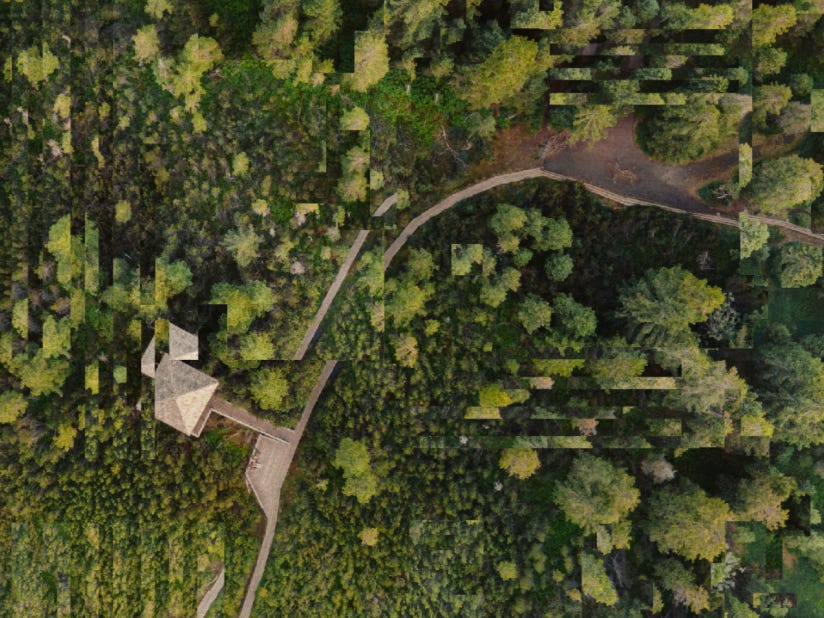
I came across this phenomenal collection from Lone Thomasky and Bits & Bäume illustrating the sobering realities behind the AI supply chain. It’s outlined “the breakdown of environments and depletion of natural resources caused by the rapid expansion of data centres and mining of critical resources (like lithium, cobalt, and rare earth elements) which underpin (generative) AI.” Check it out — here’s a sneak peek below:
People moves:
Apparel giant Nike has just appointed Cimarron Nix as its new Chief Sustainability Officer. Could it signal a comeback for the ESG agenda among consumer juggernauts? PwC seems to think so, per this report. We’ll be watching this space to see if the CSO position is getting love (and attention) amongst competitors. (ESG News)
Jessica Stahl has joined Heirloom, a direct air capture company based in San Francisco, as its Global Sourcing, Supply Chain & Capital Projects lead after a five-year stint at Walmart.
Liv Nyström joined impact fund Norrsken VC as a visiting analyst.
Former Kaluza CTO Aidan Lane left the company to launch his own consultancy, Engentic, which helps energy and utilities companies navigate technological challenges.
Data provided by Workforce.ai and verified by Verdant.
Money moves:
German AI foodtech startup Foodforecast raised $8 million from SHIFT Invest and ECBF to help curb food waste. (EU Startups)
Materials startup Shellworks raised $15 million to scale sustainable plastic alternative. (Tech EU)
Bindbridge raised $3.8 million to build crop resilience. (Ag Funding News)
Iceland-based Reykjavik Geothermal has bagged a $20 million Series B to develop its geothermal projects in its home country. (ThinkGeoEnergy)
French utility firm Engie has signed a deal to acquire UK Power Networks, the owner of the electricity cables and power lines across London, for a whopping £10.5 billion. (The Guardian)
LNG exporter Cheniere’s just been handed a $370 million tax break from the US government because it’s burning gas… which is apparently an ‘alternative fuel’ that merits a chunky windfall. N.B. Cheniere operates some gigantic ocean-going tankers, which don’t usually come under the remits of the tax clause. That, and the fact that LNG is also still a fossil fuel. (The Washington Post)
Agtech startup Rainbow Crops has secured a $7 million grant from the Bill & Melinda Gates Foundation. (Tech Funding News)
Photoncycle, a Norwegian energy storage startup, has bagged a €15 million Series A from NordicNinja and Voima Ventures. (Tech Funding News)
Have a people / money move you want us to feature? Drop us an email at verdantsubstack@gmail.com.
The global brief:
This is not an afterthought — rather, it’s a huge development that’s constantly shifting in real time, and may well be outdated by the time you’re reading this. But here’s where we’re at with global energy flows as of 5th March 2026.
Chart of the week: Crude oil exports for Iran since 2002
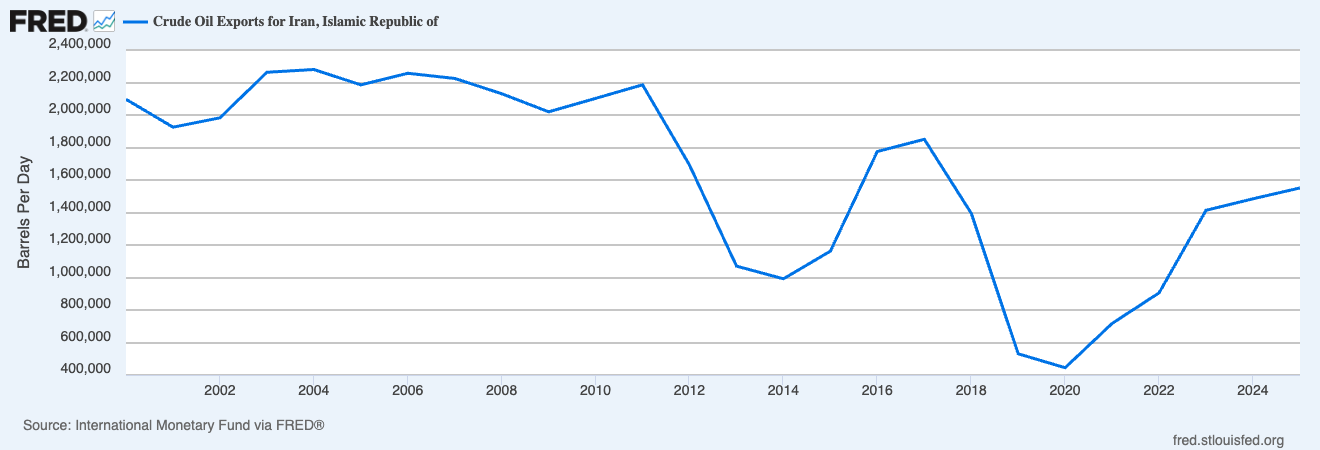
US strikes on Iran are having ripple effects on the global energy ecosystem. Namely, Iran has an outsized influence over shipping in the Strait of Hormuz, which is a strategically vital chokepoint connecting the Persian Gulf to the ocean via the Gulf of Oman. Around 1 in every 5 barrels transit through Hormuz every day, so it’s pretty important — and if there are any blockages here, global oil supplies will tighten.
Shipping firms have already diverted tankers around the Gulf because of rising security risks. Analysts are now anticipating oil prices to jump in the coming weeks, with Brent briefly hitting highs of $85 a barrel since July 2024.
This will trickle down to the everyday consumer. Petrol prices will likely spike in a few days. And any rise in transportation costs also rattles the prices of everyday goods such as produce, to airline jet fuel. Global gas markets are deeply interconnected, after all.
We don’t know the long-term outlook just yet; there are significant reserves of crude oil, and the industry has been future-proofing its energy flows around the Gulf.
Chinese refiners have been some of the biggest beneficiaries of Iran’s cheap crude, so a gap in supply could spell trouble for them. It’s also worth noting — the US now controls Venezuelan oil exports, which China primarily bought. With the potential stymying of Iranian oil supplies, China might have to look at securing a more stable supply of crude once its buffer starts to dwindle.
While Iran has been attempting to taper off its dependency on oil as the fulcrum for its economy, the country is still extremely reliant on oil revenues. Iranians are already facing exorbitant food and staple prices, and citizens will bear the brunt of any hit to the country’s energy markets.
Have a tip, insight, or opinion to share? We welcome funding news, people moves, and anything interesting happening in the climate + energy space. Drop us an email at verdantsubstack@gmail.com.
Supply chain capitalism is a concept coined by Prof Anna L. Tsing, underlining the “commodity chains based on subcontracting, outsourcing, and allied arrangements in which the autonomy of component enterprises is legally established.” Corporations fragment labour, nature, and capital across the globe to maximise profits by exploiting any regional differences in labour and resource costs.